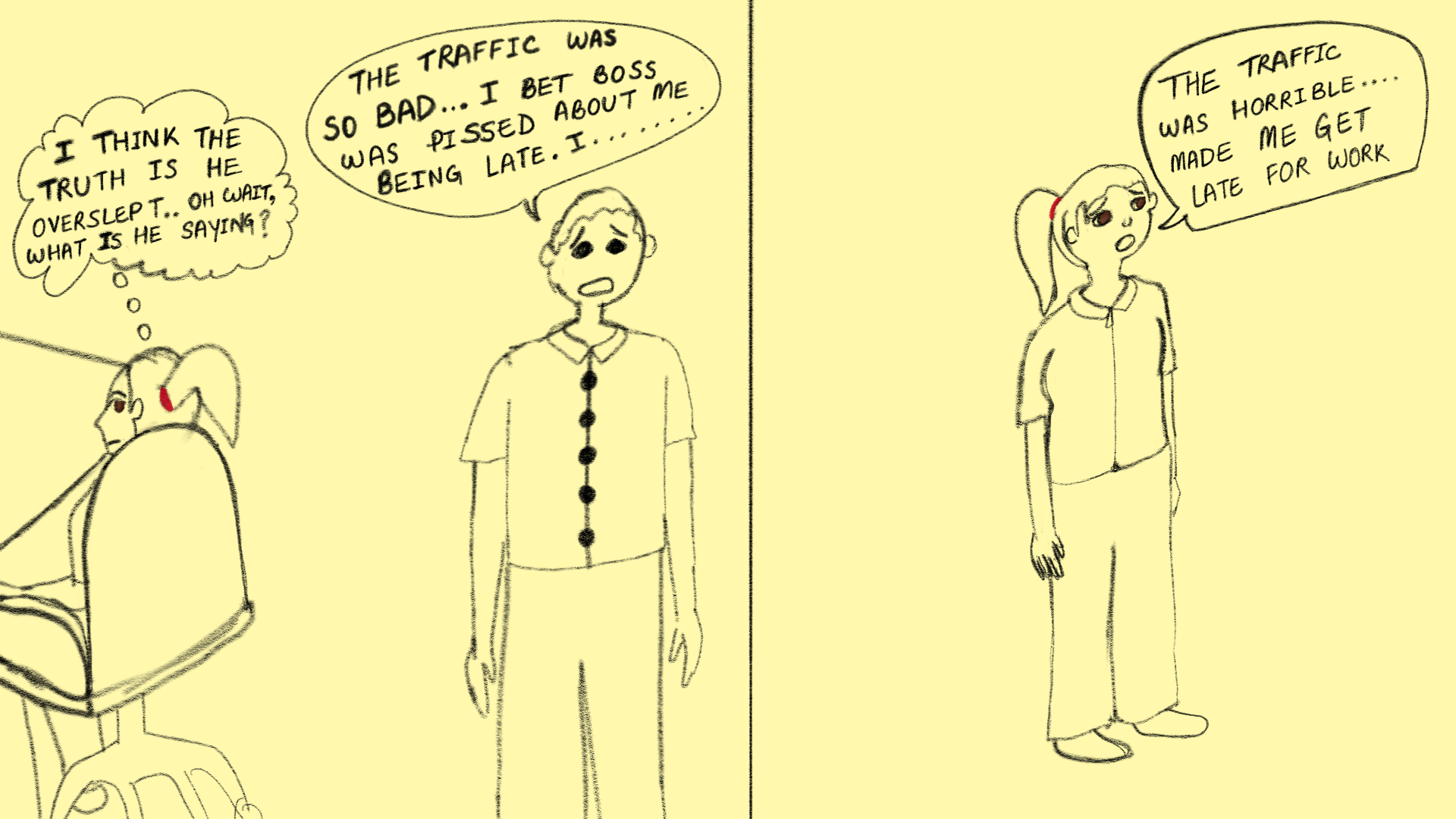
“Kacey has been running late since the moment she woke up… and she said that’s because she woke up later than her usual time. And as if her luck couldn’t be worse, she was stuck in traffic for more than half an hour, which delayed her further. When she reached her office, out of breath, she immediately said, “The traffic was so bad… I couldn’t do anything but sit there getting stressed out”. The next week, one of her coworkers was late, and he too said something similar about the traffic, but the first and loudest thought that crossed Kacey’s mind was, “He is so tardy, he was late on the first day of the week”.
^

We might have done this at least once, where we assumed that when a person did something (they made a mistake, or were late for something), it was because of things like their personality (who they are as a person) and similar dispositional factors, but we focused more on the situational factors when we did something similar (focussing on the external factors that led to us being late or making a mistake).
But, these assumptions are hardly ever accurate and even though not everybody thinks in this way for every situation, we may have done it often to be studied by social psychologists. You see, we all use rules of thumb to go about our lives, so make decisions faster and act accordingly. These rule-of-thumb situations are called heuristics, and one of them is the Fundamental Attribution Error.
What is FUNDAMENTAL ATTRIBUTION ERROR?

This is a cognitive bias where we assume that factors like personality or other dispositional factors (factors that are a person’s internal characteristics) affect their actions more, but we put more emphasis on the situational factors when we take actions.
This bias mostly emphasises the personal qualities that lead to other people’s actions (usually unpleasant or unwanted actions), but then focuses mostly on the situations which could have affected our own actions. This may look like a person skirting accountability when assessing their own actions, but only focusing on others’ personal qualities that lead to their actions.
Is this really an error?
One of the criticisms that has been highlighted about this cognitive bias is that there is a lack of clear objective norms about why we behave the way we do- instead, our own subjective worldview can shape a lot of our behaviours, so it can feel disingenuous to label this as an error (Gawronski, 2007). But we can still label it as a bias because it is not always accurate.
So why do we experience Fundamental Attribution Error?
It can be difficult to pinpoint the reasons we experience attribution errors, but one of the possible reasons discussed by researchers is that we are much more aware of the situational factors we are facing, but when we see others’ behaviour, we only see their actions… and we don’t necessarily see them as reactions to their surroundings either. The other reason could be that it is easier to look at people as being accountable for their life circumstances, but our tendency to self-preservation of our dignity may make us emphasise the external factors leading to our actions.
“When Kacey (from the example at the beginning of this post) is late for the office, she can be aware of the fact that, despite waking up late, she would have reached the office on time, had the traffic been less heavy. But she did not know what their co-worker was going through when they were late; they only saw the behaviour of being late”
This could also mean that we are perceived in similar ways by others (they see our actions as a result of who we are, but their own actions as a result of the situation)… and it is not a very comforting thought, right?
How can we reduce the instances of Fundamental Attribution Error?

Curiosity & Communication: Fundamental Attribution Error can be avoided when we approach other people with curiosity rather than believing our assumptions are the only correct way of thinking. Being curious about the reasons behind someone’s action and communicating that can make us aware of different shared and unique perspectives of why we do what we do. Curiosity and communication also open doors to being able to empathise with each other better.
References
Gawronski, Bertram. “(PDF) Fundamental Attribution Error.” ResearchGate, 2007, http://www.researchgate.net/publication/281179007_Fundamental_Attribution_Error.
Healy, Paul M. “The Fundamental Attribution Error: What It Is & How to Avoid It- Harvard Business School Online.” Business Insights, Harvard Business School, 8 June 2017, online.hbs.edu/blog/post/the-fundamental-attribution-error.
Leave a Reply