
“I don’t want to be at the mercy of my emotions. I want to use them, to enjoy them, and to dominate them.”
― Oscar Wilde, The Picture of Dorian Gray
A few years back, during one of our sessions, one of my clients spoke about his emotions, “I want to not feel anxious at work, and I don’t want to be angry at all, I want to be in control of my life”.
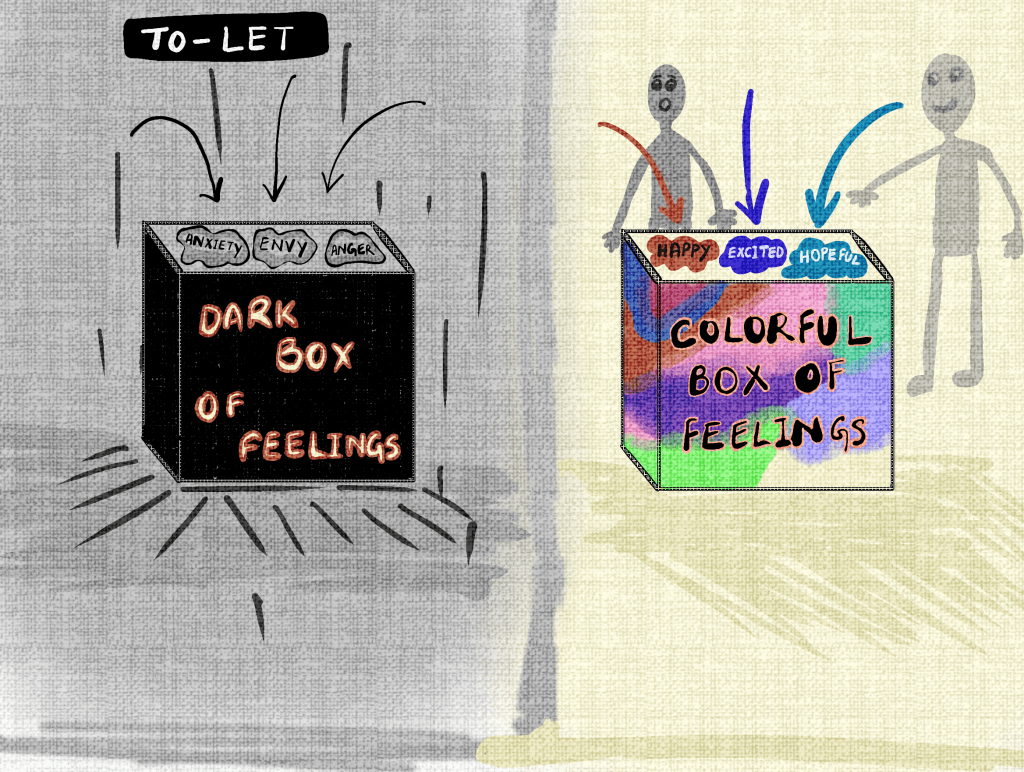
Many times, when we think of our feelings, we categorise them as negative and positive and we put one (the former) in a dark box and the latter (the more positive emotions) in a colorful box in front of us. Generally we are expected (or pushed to) focus on the colorful box alone and constantly told to push the dark box away to the darkest corner of our mind’s room. But pretending that the dark box of our “negative” emotions doesn’t exist neither takes those feelings away nor does it help us manage them. In fact, many of us might sit in the dark corner with the dark box, constantly reminding ourselves of its existence, which can also make us feel like we are drowning.
In therapy, too, many of us might have said things like, “I don’t want to feel anxious”, “I don’t want to feel angry, I want to always be calm”, or ” I want to be in control all the time”. If any of you reading this post hope to gain insight into how to always be in control, then this article might not be the one for you. Our emotions can serve an essential purpose… even the ones that seem unpleasant to experience, like jealousy, anger, and sadness. They can help us communicate with others what we are experiencing, they can tell us what we might be going through and also bond with others going through similar experiences.
An extreme example would be a mass-scale catastrophe, like an earthquake or large-scale fires, which can bring the community together in their shared grief and anxiety, and the desire to help each other during difficult times.
Managing Emotions… Regulating Emotions
Regulating our emotions isn’t really a thing about rocket science. Many of us have had multiple instances where we have managed our feelings even when things around us were “too much”. So, if you think that you can’t control your emotions, maybe it might help to rethink the times you faced emotionally overwhelming situations and did manage your feelings in public. But for the sake if this post…
… Let’s See What Emotion Regulation Is
To put it simply, it is a way for us to manage our feelings and how we respond emotionally to our environment. Whether it is controlling our feelings in a professional environment when our bosses say things that frustrate us, or managing our emotions enough to complete chores, we perform emotional regulation daily.
And what about emotion processing?
Emotion Processing is our ability to recognise, perceive and understand our emotions, and how certain emotions can facilitate action, differentiating between different emotional states and gauging what may cause an emotional reaction. Emotion processing is a skill that is associated with emotional intelligence, but it is a skill nonetheless. Which means that we can work on our ability to process our emotions until it stops feeling like a strenuous activity and more like an extension of our life. Learning to process our emotions can help us regulate our feelings eventually.
Emotion processing and emotional regulation are both aspects of emotional intelligence, but we can practice ways to develop these skills to not only manage our feelings but to understand ourselves better too.
Why is it not good to suppress our emotions?

Suppressing our emotions can make sense many times, especially when we feel unsure about how our feelings can affect others and ourselves. Many times, people use distractions like substances or food to forget their distress, and while they help… but they are temporary bandages. Suppressing emotions can not only lead to feeling overwhelmed, but for some people can cause some people to develop physical aches, pain and other physical symptoms like gastrointestinal issues too.
So, how quickly can I become a pro at emotion regulation and emotion processing?

Well, this is where many of us can push ourselves too far. Emotions exist for a reason, and we can’t always find a way out of feeling them. Since emotions can feel like waves, their intensity can taper with time. Here are a few things we can remember to start with-
- Aiming to not use emotion regulation or emotion processing skills to alleviate an emotional experience to zero (as in aiming to reduce the intensity of emotion from a scale of 10 to 0), because it might be an unrealistic goal to achieve. Instead, focusing on using the skills to make the emotions feel more tolerable, and to not put that pressure on yourself is a much more realistic goal.
- Despite knowing ways to regulate and process our feelings, we may have instances where we can’t apply those skills in our life- this can happen in highly stressful situations, or when we are still learning emotion regulation or processing skills. It might make us feel ( or see the skillsets) like failures when we react to our environment in the ‘same old way’. But taking time to see what about the situation made our emotions spill, did it still help us manage our feelings, even if a little? Curiosity can help modify the skills we learn and use them more regularly in real life.
- Practising the emotion regulation and processing skills regularly to internalise them, and not trying out new skills when we are in the middle of an emotionally overwhelming experience. For example, when people feel furious and act out, they might not find breathing exercises effective. However, consistently practising slow breathing or progressive muscle relaxation, even when we are relaxed, can benefit us more in the long run.
According to James Gross, emotion regulation can be achieved by actively modifying the way we respond to our environment or by managing our feelings after experiencing an emotionally charged event. The former teaches us to look at a situation differently, and so we might feel about it differently, too. The latter allows us to suppress our emotions in that moment without reacting in unhelpful ways.
Emotion regulation and emotion processing are not separate concepts, but rather two of the many different aspects of our emotional experiences that make us emotionally intelligent.
Emotion regulation exercises like progressive muscle relaxation can pave the way for us to process our feelings, and the method of reappraisal (or cognitive restructuring) can help us respond differently to situations and the intensity of our experiences may change too. But enough chit chat, here are three emotion regulation techniques that are response focussed.
- Picking a “sense organ” to regulate: You might have heard of the 5-4-3-2-1 technique, and maybe you tried it and found yourself focusing more on the number of things you need to see/feel/smell/hear/taste rather than grounding yourself through the five senses. Grounding techniques can be really effective, and the 5-4-3-2-1 technique is a great way to manage anxious feelings/thoughts. But you can do this exercise differently by focusing on only one sense organ instead of all five of them. Some of us feel naturally inclined towards using sound to relax, or looking out at things around us to calm ourselves. So, you can pick any one sense organ to focus on and focus on one thing first- maybe a potted plant in front you, or your pet or the spider that has made a home for itself in the corner of your room. Try to really look at it and mentally note as much detail as possible- the way it looks, the way the light might hit and the new colors that might emerge due to light reflecting on its surface. Check in with yourself to see if you notice a change in the intensity of your emotions.
- Humming: You might have heard of somatic therapy practices for emotion regulation, or practised Bhramari as a part of your Pranayama practice- humming is a great way to manage our emotions. It can calm our stress response and help regulate our autonomic nervous system by stimulating our vagus nerve.
- Colouring to Relax: Yes, you read it right. It might be time to bring out the dusty pastel boxes (or crayons) if you have any from your childhood. We don’t need to have the most expensive colour pencils or colouring books; a small box of colours and a plain notebook can do the job. The repetitive motion of colouring can be really calming, and while most of the time colouring is used during therapy with children, there is no rule barring adults from trying it out, too. Choosing simple objects like apples, boxes, and trees to colour in can be a good place to start. I have five free Mandala prints (digital art) that you can print out on my Kofi page and colour in them, or purchase any colouring materials.
- Progressive Muscle Relaxation: This can be a great way to physically relax ourselves, which in turn leads to feeling emotionally relaxed. In this exercise, we purposely tense the muscles of our body, like shoulders, jaws, and stomach muscles, for about 5-6 seconds and then release the tension by relaxing the same muscle group for 10 seconds or more. This not only helps us recognise what tensed muscles and relaxed muscles feel like, but with practice, we can start recognising our body tensing during overwhelming situations and relax physically. I have a follow-along audio on my YouTube channel linked here that anyone can practice with, but channels like “Therapy in a Nutshell (I have linked it within these texts)” also have progressive muscle relaxation videos that can be used too.
Cognitive Reappraisal: a great way to regulate our feelings
The thing with most emotion regulation practices is that they help us reduce the intensity of our emotions, but we have to take efforts to understand the reasons are we are feeling the way we do, what about the situation might make us feel this way, and are there ways we can look at the situation differently. John Gross discussed reappraisal as a way to regulate our feelings that tries to restructure the meaning of a situation.
For example, we might start feeling sad, worried or anxious if our family member doesn’t pick up their phone even after calling at least a couple of times. You might start having thoughts of catastrophic things happening and feeling overwhelmed. Practicing grounding techniques like the one mentioned above might help in the given moment but processing why we felt the way we did, are there evidences that our catastrophic thoughts are factually true and finding other reasons (and talking to the family member later) they may have not picked up the phone might help us in the long run because we can start predicting our reactions, understanding how our mind interprets things and see if we can rethink those interpretations.
I speak a little more on emotion processing in another blog post on Blogger (linked within this text), so do give it a read too. Emotion processing might not feel easy in the beginning, but with time and patience, it can become easier for us to the point that it is second nature. But being emotionally reactive sometimes doesn’t mean we are failing because our life can be unpredictable, and our emotional reactions aren’t always filtered for the outside world. Showing empathy and kindness towards ourselves can make it easier to build habits that allow us to not feel overwhelmed all the time and have better relationship with ourselves and others.
I do want to end this blog post by saying that none of my posts here or anywhere on my other pages are a replacement for therapy or provide any diagnostic tools. Therapy can definitely help with meeting personal mental health goals and finding a pace that works for you to meet these goals. These posts are meant to provide resources and knowledge compiled from existing research and applications. Feel free to contact any professional for more personalised one-to-one help.
 Psyche Bubbles
Leave a comment